Grande Armée
War and PeaceGrande Armée is the French imperial army that advances into Russia in 1812 and becomes the central military force through which the novel examines war, logistics, collective action, and historical necessity. It begins as an immense west-to-east movement of men, horses, transport, and supplies, but its apparent strength cannot overcome distance, scarcity, exhaustion, resistance, and the consequences of occupying a deserted country. Its destruction is therefore not presented simply as the result of one commander’s failure or one battle, but as a cumulative process in which an army’s material conditions and the actions of many people determine its fate.
Formation and Advance
From the end of 1811, the forces of Western Europe gathered and moved toward the Russian frontier, while Russian forces were drawn toward the same region. On June 12, 1812, the western armies crossed the frontier and began the French invasion of Russia. The scale of the movement was enormous: the millions counted in the invading force included not only combatants but also the people and resources required to transport and feed the army. Grande Armée thus appears first as a continental system of organized manpower, supply, and motion rather than merely as a body of soldiers.
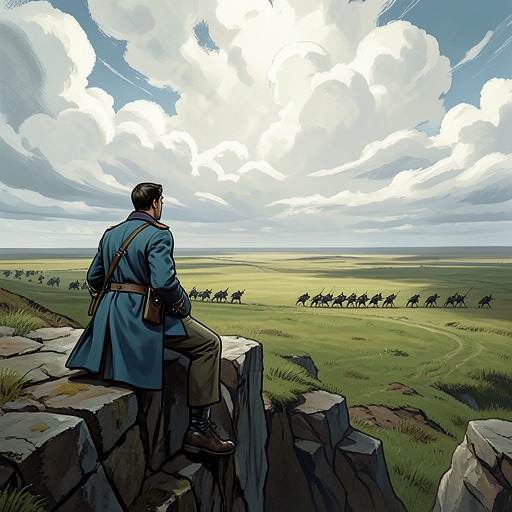
Napoleon Bonaparte personally followed the army toward the Niemen. On June 10 he overtook the advancing forces, and on the following day he went to the river in a Polish uniform to select a crossing place. Looking across at the Cossacks and the steppes beyond, with Moscow visible in the imagined geography of the campaign, he unexpectedly ordered the advance despite strategic and diplomatic considerations that might have counseled otherwise. The next day the army began crossing the Niemen.
On the morning of June 12, Napoleon watched from the steep left bank as streams of troops emerged from the Vilkavisski forest and passed over three bridges. The soldiers, aware of the Emperor’s presence, recognized him in his overcoat and cocked hat, raised their caps, and shouted, “Vive l’Empereur!” The scene gives Grande Armée the theatrical appearance of a unified instrument responding to its sovereign. Yet the later narrative repeatedly complicates that appearance, showing that an army can look obedient and centralized while its actual movement depends on innumerable independent actions.
Earlier Military Experience and Material Limits
The army’s history is set against the practical difficulties already visible in earlier campaigns. In October 1805, a Russian regiment arriving at Braunau had marched roughly seven hundred miles, while more than half its men’s boots were in holes because the Austrian commissariat had failed to issue replacements. The regiment could still be made to shine for inspection: after a twenty-mile march, the soldiers cleaned their uniforms and equipment through the night, producing an array of two thousand men in which every man knew his place. But the boots revealed the difference between outward order and material readiness. Grande Armée’s later collapse is governed by the same distinction on a much larger scale: discipline and spectacle cannot substitute for food, footwear, transport, healthy animals, and passable roads.
The Pavlograd Hussar Regiment’s experience in the 1807 campaign supplies another measure of what prolonged movement can do to an army. Stationed near a ruined German village during a thaw, the regiment endured mud, cold, broken ice, impassable roads, and the absence of provisions and fodder. Soldiers searched deserted villages for potatoes, sometimes giving their last rations to inhabitants who had almost nothing left. Although only two men were wounded in action, nearly half the regiment was lost to hunger and sickness. This contrast between battle casualties and logistical losses anticipates the fate of Grande Armée in Russia, where hunger, disease, exhaustion, and disintegration become more decisive than formal combat.
Retreat, Pursuit, and the Failure of Supply
Before the Russian campaign, the French army under Napoleon pursued a Russian force commanded by Mikhail Kutuzov along the Danube. The Russian army, numbering about thirty-five thousand, was being pursued by roughly one hundred thousand French troops, yet the superiority of numbers did not produce an immediate decisive victory. The Russians fought rearguard actions at Lambach, Amstetten, and Melk only as far as necessary to preserve their heavy equipment while retreating. Their courage was acknowledged even by the enemy, but the consequence of the engagements was a faster withdrawal, not a stable French triumph.
At Krems, Kutuzov’s exhausted army finally halted and repulsed Mortier’s division, taking banners, cannon, and two enemy generals. The Russian forces had lost a third of their number through death, wounds, sickness, and straggling, and their hospitals could no longer accommodate all the sick and wounded. The episode demonstrates that Grande Armée’s apparent momentum was repeatedly checked by the practical problem of pursuing an enemy that withdrew without surrendering its army. Victory in a local action did not necessarily bring the invader closer to a durable strategic result.
The same material pressures return during the invasion of Russia. The French advance draws millions of people and vast quantities of equipment eastward, but every mile increases the burden of feeding, transporting, and maintaining the force. The Russian response is not limited to battlefield resistance. Populations withdraw, supplies disappear, and occupied spaces cease to provide the resources an advancing army expects to find. The army’s strength is therefore undermined by the very distance that its advance was meant to conquer.
Borodino and Collective Action
At the Battle of Borodino, Grande Armée is used to challenge the idea that Napoleon’s intention directly caused the battle’s result. Napoleon ordered the commencement and conduct of the fighting, but he shot at no one and killed no one; the soldiers performed the killing. The French, Italian, German, Polish, and Dutch troops were hungry, ragged, and weary after the campaign, yet the sight of a Russian army blocking the road to Moscow made battle seem unavoidable to them. Their action arose from the collective situation in which they found themselves, not simply from obedience to a single will.
The army’s cry of “Vive l’Empereur!” intensifies this ambiguity. The soldiers shouted it after hearing Napoleon’s proclamation, just as they had shouted it at the sight of a portrait of the young Emperor piercing the globe with a toy stick. The cry expresses loyalty and enthusiasm, but it also suggests a ritual response that can attach itself to almost any imperial spectacle. Grande Armée appears united in voice while remaining composed of individuals driven by hunger, fatigue, expectation, fear, and the immediate prospect of obtaining food and rest as conquerors in Moscow.
The battle also exposes the limits of command. The narrative states that Napoleon’s orders were not executed and that during the fighting he did not know what was happening before him. His dispositions only appear worse because Borodino was the first battle he did not win; his cold on August 26 is treated as historically unimportant. The army’s fate cannot therefore be explained by a minor bodily condition or by the supposed decline of one man’s tactical intelligence. The battle emerges from the wills of hundreds of thousands of participants acting together within conditions no commander fully controls.
Moscow and the Destruction of the Army
After Borodino, the evacuation and burning of Moscow become inevitable within the novel’s interpretation of events. The departure of the wealthy and the destruction of abandoned property are presented as part of a broader Russian response that had already appeared in towns and villages beginning with Smolensk. This resistance does not depend on a single official’s plan. It grows from the movement of civilians, the abandonment of property, and the refusal to leave an intact material base for the invader.
When Grande Armée enters Moscow, its apparent victory becomes a new source of danger. The city is deserted, and soldiers spread from the Kremlin through the streets in search of quarters and valuables. Cavalrymen take abandoned houses, officers select carriages, and inhabitants who remain attempt to protect themselves by inviting commanders into their homes. The army is drawn deeper into a city whose wealth appears unlimited but whose population and organized supply have vanished.
The Fire of Moscow is not assigned to the patriotism of Count Fyodor Rostopchin, to French barbarity, or to any single group. A wooden city occupied by soldiers who smoke, light fires, and cook twice a day is structurally liable to burn, especially when its inhabitants and police force have departed. The army’s occupation therefore helps create the conditions of its own ruin. The rich city offers apparent abundance, but the fires and looting destroy both the city and the occupying force, converting conquest into entrapment.
Retreat and Dissolution
After October 28, when the frosts begin, the French retreat becomes increasingly catastrophic. Men freeze or burn themselves to death beside campfires, while carriages carrying stolen property continue to move past them. From Moscow to Vyazma, the French army numbers fall from seventy-three thousand, excluding the French Imperial Guard, to thirty-six thousand, although no more than five thousand have been killed in battle. The scale of the loss makes clear that the army is being destroyed principally outside formal combat.
The same rate of dissolution continues from Vyazma to Smolensk, from Smolensk to the Berezina River, and from the Berezina River to Vilna, independently of the precise intensity of cold, pursuit, blocked roads, or other individual circumstances. Beyond Vyazma, the army no longer advances in three columns but compresses into one mass and continues in that form. Berthier reports that the corps are almost disbanded, that scarcely a quarter of the soldiers remain with their regimental standards, and that the rest wander in search of food and escape from discipline.
This ending completes the reversal begun at the Niemen. The army that once poured across three bridges in an apparently endless stream becomes a hungry and fragmented body whose soldiers abandon standards, formations, and discipline. Grande Armée’s destruction is consequently both military and conceptual: the grand image of imperial command gives way to the exposed realities of bodies, roads, provisions, stolen goods, fire, and fatigue. Its story is the novel’s sustained demonstration that historical outcomes arise from converging material and collective forces rather than from the will of a single heroic commander.